


Judicial Profile: Benjamin J. Cheeks

Updated: Aug 10
Finding the Right Rhythm
*Written by Eva Dech
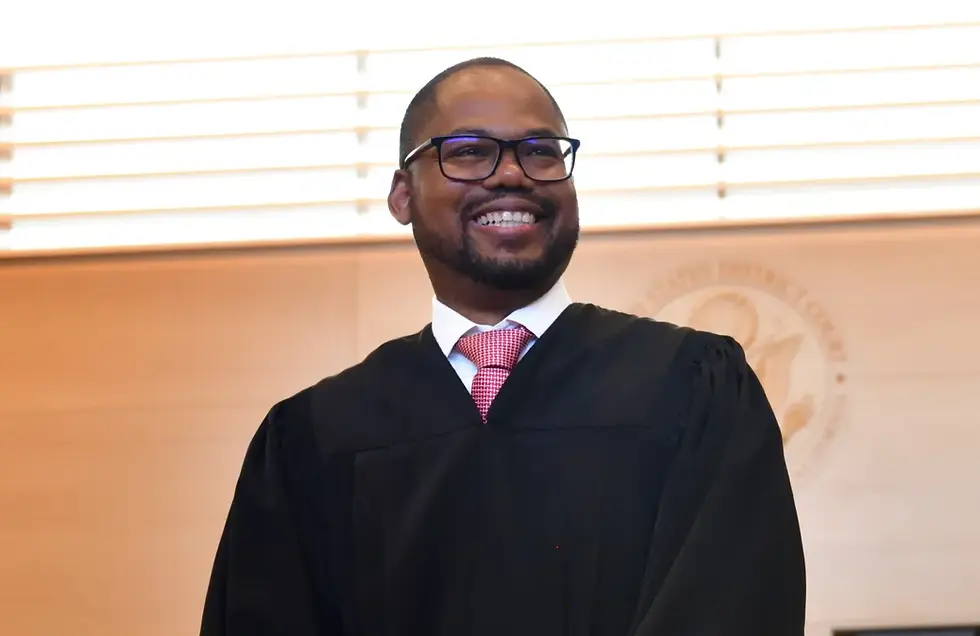
Step into Judge Cheek’s chambers and you will quickly realize that music is not just background noise—it is part of the atmosphere. His first guitar is prominently displayed close to another that is ready to be played. Prince albums share shelf space with a Morris Day record, subtle reminders that while the courtroom demands precision, life is richer with a good soundtrack.
Long before taking the bench, Judge Cheeks was also part of a hip-hop dance group—a fact that surprises many who know him today as thoughtful and measured. He has always had a love for music. And these days, he is dancing again, taking lessons once a week as part of his commitment to staying active and making time for himself.
That philosophy of balance has become one of his guiding principles: “Put your own mask on first so you can help those around you,” he says. “Take care of yourself physically and mentally.”
His journey to the federal bench began in Fort Lauderdale, Florida, where he also met the woman who would become his wife, mother of his children, and love of his life. They first met when they were just 14 years old but did not begin dating until they attended the University of Miami together.
When she was accepted into her doctoral program at Columbia University in New York, Judge Cheeks followed his own path north, attending American University Washington College of Law in Washington, D.C. During his second summer of law school, he landed an internship with the Manhattan District Attorney’s Office Appeals Bureau. The professional opportunity was excellent—but he admits there was another reason for choosing New York: it was a good excuse to spend the summer closer to his then girlfriend.
After graduation, he joined the Manhattan District Attorney’s Office full-time in the Appeals Bureau. Naturally quiet and reserved, he found the appellate work rewarding for three years before moving into the Narcotics Section.
There, nearly every case required presentation to a grand jury, and defendants frequently testified. The experience transformed him into a seasoned cross examiner.
He later spent a year in the office’s Special Prosecutions Unit, working with the Immigrant Affairs Program. The work focused on protecting undocumented immigrants who had been victimized or exploited.
“It was feel-good work,” he says. “Helping some of the most vulnerable people—it felt righteous.”
His desire to become a prosecutor had even deeper roots. Having been the victim of crimes as a young person, he entered the profession wanting to help others and pursue justice.
Eventually, another life decision changed the tune.
His wife traveled to San Diego to receive an award and returned home with a glowing report.
“She came back and said, ‘There’s paradise in the United States, and it’s San Diego.’”
The couple made the move west, and Judge Cheeks joined the U.S. Attorney’s Office, where he appreciated the structure and organization of federal practice. But after several years, he found himself grappling with the cycle of defendants’ recidivism: “I felt I could make a bigger impact on the defense side.”
He entered private practice, spending more than a decade representing individuals in federal court.
“I really enjoyed having a positive and direct impact on people’s lives.”
After years as a defense attorney, however, he sensed it was time for another challenge.
“The work became slightly predictable, and I felt like I had more to contribute to society. Becoming a judge felt like the natural progression—a brand-new journey.”
The transition has been rewarding—and humbling. After spending his career almost exclusively in criminal law, stepping into the world of civil litigation was like learning to play a new instrument. The breadth and complexity of civil practice have presented a fresh intellectual challenge—one he has embraced with humility, curiosity, and a willingness to keep learning every day.
While every day presents new legal questions, the weightiest responsibility remains making decisions that profoundly affect people’s lives.
“The hardest part [of being a judge] is making sure you get it right,” he says. “People are affected by your decisions, and you want to make sure they’re the correct ones.”
Sentencing hearings are especially significant. The anxiety builds leading up to sentencing where Judge Cheeks has no tentative rulings, giving the parties his undivided attention. “But once I impose the sentence, the anxiety is gone because I’ve done everything I can to reach the right decision.”
Despite the gravity of the role, Judge Cheeks is intentional about the atmosphere he creates in his courtroom, pledging to never get “mean” on the bench. Colleagues and practitioners have already noticed that commitment reflected in his kindness, patience, and respect for everyone who appears before him.
When asked what advice he would give to younger lawyers, his answer comes without hesitation: “Don’t self-limit. Don’t take yourself out of the game by deciding you’re not ready. Let someone else make that decision—don’t make it for yourself, in other words, don’t let your fears stop you from trying.”
Outside the courthouse, Judge Cheeks enjoys some of San Diego’s simplest pleasures. His favorite beach to unwind is La Jolla Shores, where he can relax by the ocean. He is proudly a night owl, reaches for coffee over tea every time, and considers popcorn the perfect snack.
And if music is still playing in his chambers, that is by design because music has long been a constant presence in Judge Cheek’s life, providing a sense of familiarity and calm that fosters concentration.
Every career has its own soundtrack. Judge Cheek's has moved from hip-hop dance rehearsals to appellate arguments, grand jury presentations, defense advocacy, and now the federal bench. Through each movement, the rhythm has changed, but the melody has remained remarkably consistent: a commitment to serving others with humility, compassion, and integrity.
Asked what he enjoys most about being a judge, his answer captures the theme that has connected every chapter of his career.
“I have the best job because I have a genuine opportunity to help the greatest number of people.”
*Eva Dech is the Vice President of Public Relations for SD's FBA Chapter. A Colorado native, California Western School of Law graduate, and former law clerk for Magistrate Judge Butcher, Eva is transferring as an Assistant United States Attorney to the District of Puerto Rico.


